People in my faith tradition love the Bible.Thoughts?
You may think that you too love the Bible, but you're wrong. We really, really love the Bible. We attend Bible class and Bible camp. Our kids learn about the Bible and compare their knowledge in "Bible Bowl". To protect our Bibles, we carry them in special zippered bags. We give one another guilt about reading the Bible. We claim that "we speak where the scripture speaks, and are silent where the scripture is silent." (By "the scripture", we of course mean "the Bible".) We even sing songs about ... you guessed it ... the Bible.
There are some good, historical reasons for this attitude, and very few people know or care about those reasons. Because in our tradition, history isn't very interesting, and neither is Biblical interpretation, really. There is no such thing as "interpreting" the Bible. It simply says what it means, and means what it says ... and what it means and says are what we've always said that it says and means.
It wasn't a bad way to grow up. I sailed along happily, riding this wave of certainty, singing about how I loved the Bible and how I wished someone would give me a Bible and how much I loved Bible camp, until one year at said Bible camp, something happened that roughened the seas a bit.
Every year, at the end of the week, the boys and the girls of each age group would engage in a Bible trivia competition. That year we had been studying 1 and 2 Timothy -- you know, the authoritarian epistles -- and we boys were, like every year, pretty much resigned to losing. The girls always beat us. But somehow, this year, perhaps buoyed up by the writer's exhortation that women should learn "in quietness and full submisssion", we eked out a win.
The girls were downcast. We were jubilant. And in the middle of our celebration, someone (I'm pretty sure it wasn't me) purloined the words of 2 timothy 3 for a victory chant:
"Weak-willed women. Weak-willed women! Weak-willed women!"
We all chanted together, rejoicing in our superior Bible knowledge.
"Weak-willed women!"
Then I noticed that one of the girls was crying, quietly.
If you've ever been a junior-high boy, you will probably know what happens when you see the tears of a junior-high girl who is kind, intelligent and more than a little bit cute.
You're utterly befuddled.
You walk back to your cabin, deeply confused. And as you process the situation, you start to notice that something is wrong. You're not quite sure what yet, but something, you know, is terribly wrong.
After a few years, you figure it out: something must be wrong with the Bible. Friends and acquaintances are abandoning their faith because they can't follow a God who would order genocide, or denigrate women, or abhor gays. And they can't simply ignore a few Bible verses and go on with their faith, because if they learned anything growing up in church, they learned this: either all of the Bible is true, or none of it's true.
But soon after, you realize that maybe nothing is wrong the Bible; maybe something is broken about how you're interpreting it. And if something is broken about how you're interpreting it, maybe something is also wrong about how you're applying those interpretations. Over time, and with quite a bit of help, you begin feeling your way out of the darkness of Christian fundamentalism and the trap of biblical literalism. You can see the contradictions in the text now, but they don't scare you. They simply point to he beautiful frailty of the real people behind the Bible, a frailty that you see all around you every day. As you change the way you interpret the Bible, you change your theology. You begin ignoring those parts of the Bible that endorse prejudice, or misogyny, or genocide. You allow other voices, like science and your own experience, to inform your understanding of God.
Then you wake up one morning and realize that you don't fit in at church. Not only don't you fit in, but you're not really welcome, and you don't particularly like being there.
And that's where I found myself a few weeks ago.
I realized that while my church is admirable in its attempts to pursue social justice and racial integration, its justifications for doing so, and its core theology, were essentially fundamentalist. My church is great in that it has no creeds, no membership, no checklist telling us who's in and who's out, but underlying all of its programs, all its deliberations about church leadership, all its expressions of worship and interactions with the surrounding community was this fundamental, axiomatic belief that the Bible is the infallible word of God. And that made church exhuasting.
Instead of singing, I spent my time trying to translate the song lyrics into metaphors I could affirm.
Instead of praying, I spent my time pondering the moral bankruptcy of a God who would grant any of our prayer requests, while every day, thousands of people starved to death. I tried not to be appalled at people who would follow such a God.
Instead of speaking the standard Jesus-speak, or providing perspectives that would contradict the established church culture, I tried to keep my mouth shut. I mostly failed at that, though, which mostly made me feel like a curmudgeonly bastard.
I became desperately grouchy, because I was always having to define my faith in terms of what I didn't believe, and I didn't have any spiritual mentors who could show me the way to a positive, progressive faith. (Thank God for the Internet, right? People like Paul and Crystal kept me afloat ... I want to kiss them.)
Finally, I realized that being at church wasn't doing me any good. It wasn't making me a more virtuous person, and it wasn't even making me feel good. Going to church was like poking myself in the eye with a sharp stick, and it would probably be better for everyone involved if I just STOPPED POKING MYSELF IN THE EYE WITH A STICK.
So I did. And now I feel better.
In the future, I may return to a church. My roots are there, my family is there, and I'd like to try to help people who are looking for an alternative to fundamentalism. But for now, I have to figure out the next few lines of my story.
I'd like to find a faith community that exhibits the virtues that I hope to learn. I'd like to find mentors who can express their progressive faith in positive terms. I'd like to see if I can learn some wisdom from other faith traditions, because there are books other than the Bible. I've even read a few of them, and while in lots of places they're as scary as the Bible in the hands of an angry fundamentalist, there always seems to be something to learn about love, or people, or God.
And one last thing: for those of you who might be worried about my apostasy, have no fear. God is out here too.
The God who made the world and everything in it is the Lord of heaven and earth and does not live in temples built by hands. And he is not served by human hands, as if he needed anything, because he himself gives all men life and breath and everything else.
Showing posts sorted by relevance for query bible. Sort by date Show all posts
Showing posts sorted by relevance for query bible. Sort by date Show all posts
Wednesday, February 13, 2008
Liberal Jesus: Taking a Break From Church
One of my blogfriends, Greg Kendall-Ball, shared this post the other day and it really resonated with me on several levels and I was curious about other people's reactions to it. It's from a blog called Liberal Jesus.


Friday, February 08, 2008
The Bible Tells Me So: Answering a Question
I wanted to take one more post and answer a thought that Thomas+ proposed in last week's post.
Let me start out by saying that I am very grateful to God for bringing Thomas into my life. Starting from Church of the Redeemer meeting at the old Otter Creek building to our association in the Nashville Cohort, he has been someone who provides some good perspective on several of the questions that I've been asking.
The thought that Thomas had was this:
However, I don't that it's as easy to separate the Bible from the God of the Bible. If our entire definition(s) of God come from the Bible, then something that I have to deal with is one on hand, the truth of the Bible, and on another, the literal or figurative historicity of the Bible. Where I'm trying to get is maybe to not focus on the literal/figurative section. And maybe this is simply a step that I'm having to go through to a different understanding of it.
You see, my faith has always been lived through the lens of the Bible. And part of that problem is that if I'm honest with myself, I do have a lot of questions about the authors and the literalness of it. And if I begin to doubt the reliability of Scripture, then the natural next step is to doubt the faith that I have gained because of the Bible and the interpretations of it.
So what I'm trying not to is throw the baby out with the bathwater. If my view of Scripture is not the traditional (kind of) literal view of Scripture that I've had most of my life, then how does my faith change? Do I lose my faith? Perhaps some will, but I don't think I will. My faith is too important to me to let a changing view of Scripture and the God revealed within that Scripture subvert it.
I feel like I'm rambling a lot here, but there are some deep-seated questions that I'm wrestling with while trying to be honest with myself (and all of you). I don't know if that clears anything up or not or just muddies the waters more.
Let me start out by saying that I am very grateful to God for bringing Thomas into my life. Starting from Church of the Redeemer meeting at the old Otter Creek building to our association in the Nashville Cohort, he has been someone who provides some good perspective on several of the questions that I've been asking.
The thought that Thomas had was this:
Ultimately, I think Phil's problems have little to do with literal vs. figurative. It sounds much more like he is concerned about the character of God. He sounds like he would prefer a "kinder, gentler" god than the one he sometimes sees in the Bible. I understand that, having felt the same way many times.Thomas is not wrong on this. It's not the only question, but it certainly is a part of it. As I stated in the Old Testament part of this series. It does bother me that the God who is defined as love in the New Testament would call for the genocide of the Canaanites.
But I think he is hiding behind figurative vs. literal. I could be wrong, certainly, but I think this is more about the God of the Bible than the Bible itself.
However, I don't that it's as easy to separate the Bible from the God of the Bible. If our entire definition(s) of God come from the Bible, then something that I have to deal with is one on hand, the truth of the Bible, and on another, the literal or figurative historicity of the Bible. Where I'm trying to get is maybe to not focus on the literal/figurative section. And maybe this is simply a step that I'm having to go through to a different understanding of it.
You see, my faith has always been lived through the lens of the Bible. And part of that problem is that if I'm honest with myself, I do have a lot of questions about the authors and the literalness of it. And if I begin to doubt the reliability of Scripture, then the natural next step is to doubt the faith that I have gained because of the Bible and the interpretations of it.
So what I'm trying not to is throw the baby out with the bathwater. If my view of Scripture is not the traditional (kind of) literal view of Scripture that I've had most of my life, then how does my faith change? Do I lose my faith? Perhaps some will, but I don't think I will. My faith is too important to me to let a changing view of Scripture and the God revealed within that Scripture subvert it.
I feel like I'm rambling a lot here, but there are some deep-seated questions that I'm wrestling with while trying to be honest with myself (and all of you). I don't know if that clears anything up or not or just muddies the waters more.
Friday, January 11, 2008
The Bible Tells Me So
I was planning today to write a piece about reading the Bible and if there is a mature way to come to be able to take the Bible seriously, but not completely literally. And then I realized that I'd already basically done that last June.
I don't know why I'm having so much trouble with Scripture these days. If you search for Bible on my blog, you can see how much I've been struggling with it. Just in the last couple of years, I've been digging and thinking and pondering about the nature of Scripture and our relationship to it. I'm getting to the point where I believe that the Bible is part of God's work in our world, but not the only part. I'm getting to the point where I believe that the Bible is from God, but not inerrant. I've been at the point for awhile where I believe that God inspired the Bible, but that didn't preclude people's tendency to inject personal issues, foibles, and perspectives.
I guess what I'm wrestling with the most is what is the place of Scripture in the life of a Christian who believes that God inspired it, but doesn't believe that it is inerrant, infallible, or whatever other theological words we come up with. And the big question even in that is, how do we decide which parts to follow? Do we cherry pick the parts we like and ignore the parts we don't (not that most Christians don't already do that)?
I'm trying to come to a position of respect and honoring of the Scriptures, but not deifying them, not creating them as a new god to be worshipped, as I and others have probably unintentionally done. And I hope and pray that that leads me to a greater respect for them, the people that wrote them, and the God I believe inspired them.
I don't know why I'm having so much trouble with Scripture these days. If you search for Bible on my blog, you can see how much I've been struggling with it. Just in the last couple of years, I've been digging and thinking and pondering about the nature of Scripture and our relationship to it. I'm getting to the point where I believe that the Bible is part of God's work in our world, but not the only part. I'm getting to the point where I believe that the Bible is from God, but not inerrant. I've been at the point for awhile where I believe that God inspired the Bible, but that didn't preclude people's tendency to inject personal issues, foibles, and perspectives.
I guess what I'm wrestling with the most is what is the place of Scripture in the life of a Christian who believes that God inspired it, but doesn't believe that it is inerrant, infallible, or whatever other theological words we come up with. And the big question even in that is, how do we decide which parts to follow? Do we cherry pick the parts we like and ignore the parts we don't (not that most Christians don't already do that)?
I'm trying to come to a position of respect and honoring of the Scriptures, but not deifying them, not creating them as a new god to be worshipped, as I and others have probably unintentionally done. And I hope and pray that that leads me to a greater respect for them, the people that wrote them, and the God I believe inspired them.
Friday, January 18, 2008
The Bible Tells Me So: The Old Testament
Last week, I wrote about trying to find a spiritually mature way to take the Bible seriously without taking it completely literally.
So, let's think about what this could possibly mean for the Old Testament. Wait, before we do that, a few disclaimers. I am not a Biblical scholar. I took Bible classes everyday in college at Lipscomb University for 4 years, but things like this weren't really discussed. I'm a neophyte who's thinking off the top of my head and I could be way off base here.
Ok. Let's start at the beginning. I talked last year about how when someone asks you how old the earth is, they're really asking what you think of the Bible. But let's just take for a second that the Biblical account of creation is mythical and the current scientific understandings about the beginning of life and the universe is closer to correct. What does that mean for a Christian? Well for some, it means that the rest of the Bible isn't trustworthy. If that one part is wrong or incorrect, it means that the whole thing collapses. For someone else, what it could mean is that the author of Genesis was reflecting the understandings of his (or her) time and assuming God's action in that. Did they believe it? Probably, but that doesn't preclude it from being scientifically incorrect. Now, should we put our complete "faith" in scientific understanding? No, but one thing that science does is allow the possibility of saying, "I don't know." Scientists don't know what caused the presumed "Big Bang;" they don't know what sparked proteins to come together to start the cycle of life. And to me, that leaves open the possibility of God's action in that.
That one is one that a lot of people have thought about. But another piece of the OT that I've thought a lot about are God's commands to Joshua in the same named book to completely annihilate the Canaanites. He tells them to utterly destroy them: men, women, and children (Joshua 8). I really have two issues with this: 1) it seems to go against the God is Love declarative in 1 John; 2) it makes God seem like a racist and "bad." Why would he direct the destruction of children? So, what if what we're reading is the writing of someone who is inserting God and an understanding of His word into their actions. Basically giving His sanction to the actions that they're doing. Telling history from their perspective. Someone once said, "You can be sure that you've created God in your own image when He hates the same people that you do." Was that going on here with the Israelites?
Now what that opens me up to is someone saying, "But Phil, aren't you just trying to explain away the parts that you don't understand or don't agree with to fit into your understanding?" Well, maybe, but the alternative is taking a view of a God inconsistent from the New Testament God, and that's a dangerous road to consider, in my mind.
Yes, I realize I'm opening a can of worms, playing with fire, insert cliche here. But if I'm being honest with my thoughts and my faith, this is what I have to do and questions I have to ask and try to come to some resolution on.
Next Friday, the New Testament and why I tend to take it quite a bit more literally than the Old.
So, let's think about what this could possibly mean for the Old Testament. Wait, before we do that, a few disclaimers. I am not a Biblical scholar. I took Bible classes everyday in college at Lipscomb University for 4 years, but things like this weren't really discussed. I'm a neophyte who's thinking off the top of my head and I could be way off base here.
Ok. Let's start at the beginning. I talked last year about how when someone asks you how old the earth is, they're really asking what you think of the Bible. But let's just take for a second that the Biblical account of creation is mythical and the current scientific understandings about the beginning of life and the universe is closer to correct. What does that mean for a Christian? Well for some, it means that the rest of the Bible isn't trustworthy. If that one part is wrong or incorrect, it means that the whole thing collapses. For someone else, what it could mean is that the author of Genesis was reflecting the understandings of his (or her) time and assuming God's action in that. Did they believe it? Probably, but that doesn't preclude it from being scientifically incorrect. Now, should we put our complete "faith" in scientific understanding? No, but one thing that science does is allow the possibility of saying, "I don't know." Scientists don't know what caused the presumed "Big Bang;" they don't know what sparked proteins to come together to start the cycle of life. And to me, that leaves open the possibility of God's action in that.
That one is one that a lot of people have thought about. But another piece of the OT that I've thought a lot about are God's commands to Joshua in the same named book to completely annihilate the Canaanites. He tells them to utterly destroy them: men, women, and children (Joshua 8). I really have two issues with this: 1) it seems to go against the God is Love declarative in 1 John; 2) it makes God seem like a racist and "bad." Why would he direct the destruction of children? So, what if what we're reading is the writing of someone who is inserting God and an understanding of His word into their actions. Basically giving His sanction to the actions that they're doing. Telling history from their perspective. Someone once said, "You can be sure that you've created God in your own image when He hates the same people that you do." Was that going on here with the Israelites?
Now what that opens me up to is someone saying, "But Phil, aren't you just trying to explain away the parts that you don't understand or don't agree with to fit into your understanding?" Well, maybe, but the alternative is taking a view of a God inconsistent from the New Testament God, and that's a dangerous road to consider, in my mind.
Yes, I realize I'm opening a can of worms, playing with fire, insert cliche here. But if I'm being honest with my thoughts and my faith, this is what I have to do and questions I have to ask and try to come to some resolution on.
Next Friday, the New Testament and why I tend to take it quite a bit more literally than the Old.
Friday, September 30, 2005
Christian Idolatry
It was great having Adam Ellis spend last week with us as he was taking his grad class at Lipscomb. Not only did I get to talk theology and play Halo2 with him, I got to get his class notes and he gave me a slew of CDs with talks, lectures, and sermons on them. Rob Bell, NT Wright, Stanley Grenz, Mike Cope, and Randy Harris. One in particular from Randy Harris hit me like a sledgehammer to my forehead.
Harris is speaking to a unity meeting between Churches of Christ and Independent Christian Churches. To give some context, in 1906 the U.S. Census Bureau officially recognized a split in the Christian Church along denominational lines, based particularly on the use of instrumental music but there were others, with the Churches of Christ going non-instrumental and Christian Churches going instrumental, and I’ve really simplified that. With the 100 year anniversary of this event coming up, there have been unity meetings concerning trying to get back together in some areas and the event Harris is speaking at is one of those.
The talk was called “Focusing Your Vision.” He was assigned to talk about Exodus 32:1-6 and he digs deeply into idolatry. The point he makes from this passage and it’s very clear in verse 5 is that the people of Israel did not abandon the worship of God/YHWH; they added the worship of idols to their worship of God. And this becomes a pattern for the people of Israel, with Solomon and Ahab being primary examples.
Of course, Harris doesn’t let us in the church go scot-free. He gives a three part quiz to tell if we are idolaters or not.
Now, I could talk a lot about those three things, but it’s in the first one that Harris really hit me. He said there are three examples of this in how the Churches of Christ and Christian churches are totally united.
There’s a lot more in this talk, particularly about the ways that Harris gives to avoid these idolatries. I wish all of you could hear it, but as I’ve listened to it three times in the last week, it’s had a strong affect on me. If you know me or are coming to the Zoe Conference next week, we might be able to work something out so that you could hear it.
I pray that God gives us the strength to stop worshipping our idols and devote ourselves totally to Him.
Harris is speaking to a unity meeting between Churches of Christ and Independent Christian Churches. To give some context, in 1906 the U.S. Census Bureau officially recognized a split in the Christian Church along denominational lines, based particularly on the use of instrumental music but there were others, with the Churches of Christ going non-instrumental and Christian Churches going instrumental, and I’ve really simplified that. With the 100 year anniversary of this event coming up, there have been unity meetings concerning trying to get back together in some areas and the event Harris is speaking at is one of those.
The talk was called “Focusing Your Vision.” He was assigned to talk about Exodus 32:1-6 and he digs deeply into idolatry. The point he makes from this passage and it’s very clear in verse 5 is that the people of Israel did not abandon the worship of God/YHWH; they added the worship of idols to their worship of God. And this becomes a pattern for the people of Israel, with Solomon and Ahab being primary examples.
Of course, Harris doesn’t let us in the church go scot-free. He gives a three part quiz to tell if we are idolaters or not.
- If we pay more attention to the seen and the present than to what lies behind it even if what is seen and present is good.
- If we give part of our lives wholly and completely to God and have other parts where God barely touches it.
- If we talk more than we listen.
Now, I could talk a lot about those three things, but it’s in the first one that Harris really hit me. He said there are three examples of this in how the Churches of Christ and Christian churches are totally united.
- Nationalism
We have married the destiny of the church and of the Kingdom of God with America's destiny to such an extent that we are far less willing to take the hand of our brothers and sisters in other countries than we are to grab our flag or a gun to kill them. The Kingdom of God existed long before America did and will exist long after she is gone. The prayer should not be “God Bless America” or even “God Bless the World through America.” In my opinion, it should simply be, “May Your Kingdom Come.” - Ecclesiolatry
We have made the church into an idol. We have made doing church in a certain way so important that we lose the reason for doing church, i.e. the gathering of the community of faith, whether on Sunday morning with 800 people or Friday at lunch with two. This is one of the reasons I love the discussion Tim Woodroof (my preacher) has of this in A Church that Flies. We have forgotten that form should come out of function, not the other way around. - Bibliolatry
We have made the Bible into an idol. I have definitely seen this one in the Churches of Christ. We have made the Bible God, not the Word of God. We have put the Bible in such a place that we forget that the Bible points to and reveals God; it is not God. We have made the interpretation of certain passages litmus tests for faithfulness and forgotten that Scripture was not written in a vacuum. It was written by men (and women) who existed in a certain culture, just as we exist in a certain culture that we read it through. It is simply impossible to read the Bible totally objectively. Just the fact that we’re reading it in English means it was interpreted in a certain way.
There’s a lot more in this talk, particularly about the ways that Harris gives to avoid these idolatries. I wish all of you could hear it, but as I’ve listened to it three times in the last week, it’s had a strong affect on me. If you know me or are coming to the Zoe Conference next week, we might be able to work something out so that you could hear it.
I pray that God gives us the strength to stop worshipping our idols and devote ourselves totally to Him.
Monday, May 07, 2007
The Question
As I was working on the play I was doing sound for this weekend, there was some downtime. I was sitting around with some of the actors, none of whom I knew before last week. We were talking about the Bible and the Genesis stories of creation, and one of them turned to me and asked, "Phil, how old do you think the earth is?" And immediately, I knew what the real question was. It was a test question. The guy didn't really want to know how old I thought the earth was. His real question was, "Phil, do you think the Bible is inerrant, infallible, authoritative, and trustworthy?"
You see, in my mind, the whole flap about Creationism vs. Evolution is not really about Creationism or Evolution. It's really about whether someone believes that the Bible is completely inerrant, which interestingly is not a term the Bible uses in reference to itself...
My answer to him was a bit of a dodge, mainly because I wasn't feeling combative. I told him that no one really knows how long it was from the Creation to the Fall, and how Bishop what's-his-name (Ussher, I later looked up) thought the Earth was about 6,000 years old. I then did bring up the fossil record, and he brought up the idea of God creating matter to look old, which makes no sense to me at all. Things were getting cranked back up so we didn't have time to continue and didn't get back to it.
So, how would you have responded?
You see, in my mind, the whole flap about Creationism vs. Evolution is not really about Creationism or Evolution. It's really about whether someone believes that the Bible is completely inerrant, which interestingly is not a term the Bible uses in reference to itself...
My answer to him was a bit of a dodge, mainly because I wasn't feeling combative. I told him that no one really knows how long it was from the Creation to the Fall, and how Bishop what's-his-name (Ussher, I later looked up) thought the Earth was about 6,000 years old. I then did bring up the fossil record, and he brought up the idea of God creating matter to look old, which makes no sense to me at all. Things were getting cranked back up so we didn't have time to continue and didn't get back to it.
So, how would you have responded?
Friday, February 01, 2008
The Bible Tells Me So: Implications
In the last few weeks, on Friday, I've been thinking about the idea of taking Scripture seriously if not always literally. I've talked about my thoughts on the Old Testament and also why I tend to take the New Testament more literally. So for the final thoughts on this, I wanted to think about the implications of this mindset.
In my mind, there are basically three ways of interpreting Scripture, each with flaws.
With the third way, there's discernment and study that have to go into determining what is intended to be taken literally and figuratively. In a way, this mindset would seem to free up the Bible to be what it seems like it was meant to be, not completely a rule book or law book to be followed completely (which almost no one does). To me, it is a way to acknowledge Scripture both as God breathed and human influenced, because I don't think the two are mutually exclusive.
In my mind, there are basically three ways of interpreting Scripture, each with flaws.
- Entirely literally, which can lead to such things as believing that God (or Satan) planted the dinosaur fossils to challenge our faith and make it difficult to believe in God and the Bible.
- Entirely figuratively, which in my mind loses much of the value of Scripture, particularly when it comes to Jesus and His Resurrection, something I view as central to Christian faith.
- And then the way that I've been thinking, a combination of literal and figurative, which as I discussed in the first installment of this whole thing, can lead to cherry picking which Scripture we decide are literal and which are figurative, although .
With the third way, there's discernment and study that have to go into determining what is intended to be taken literally and figuratively. In a way, this mindset would seem to free up the Bible to be what it seems like it was meant to be, not completely a rule book or law book to be followed completely (which almost no one does). To me, it is a way to acknowledge Scripture both as God breathed and human influenced, because I don't think the two are mutually exclusive.
Friday, June 01, 2007
Reading the Bible
If you're a regular reader of this blog, you know that I've really been wrestling with reading Scripture and how we as 21st century people should read the Bible written anywhere from 4,000 to 2,000 years ago.
There are two general schools of thought on this.
So I want to take a quick shot at a theology of Scripture and shoot holes in it (Hi, Thomas+ ;-) ), find where it works, where it doesn't, where it's orthodox, where it fails.
In 2 Timothy 3:14-17, Paul says
Is that even a reasonable suggestion? Is it possible to follow that ideology of Scripture and still maintain respect for it? Or do we have to keep saying that we're New Testament Christians, happily ignoring calls for Holy Kisses and washing feet?
There are two general schools of thought on this.
- The Bible is the totally inspired Word of God and we are obligated as God's children to follow His Word and the examples laid forth to the letter. And admittedly, in the West Wing clip from yesterday, Jed Bartlett thoroughly skewers someone who apparently buys into this mindset, by pointing out the inconsistencies in the practice of her theology.
- The Bible was written by men or women who were flawed and influenced by their culture resulting in directives that allow for the selling of a daughter into slavery or even against homosexuality.
So I want to take a quick shot at a theology of Scripture and shoot holes in it (Hi, Thomas+ ;-) ), find where it works, where it doesn't, where it's orthodox, where it fails.
In 2 Timothy 3:14-17, Paul says
Now, obviously, he's talking here about the Old Testament. What's interesting is that Paul makes another reference (not the only one but a similar one) in I Corinthians 10 where he says:2 Timothy 3:14-17 (New International Version)
14But as for you, continue in what you have learned and have become convinced of, because you know those from whom you learned it, 15and how from infancy you have known the holy Scriptures, which are able to make you wise for salvation through faith in Christ Jesus. 16All Scripture is God-breathed and is useful for teaching, rebuking, correcting and training in righteousness, 17so that the man of God may be thoroughly equipped for every good work.
1 Corinthians 10:1-13 (New International Version)
1For I do not want you to be ignorant of the fact, brothers, that our forefathers were all under the cloud and that they all passed through the sea. 2They were all baptized into Moses in the cloud and in the sea. 3They all ate the same spiritual food 4and drank the same spiritual drink; for they drank from the spiritual rock that accompanied them, and that rock was Christ. 5Nevertheless, God was not pleased with most of them; their bodies were scattered over the desert.6Now these things occurred as examples to keep us from setting our hearts on evil things as they did. 7Do not be idolaters, as some of them were; as it is written: "The people sat down to eat and drink and got up to indulge in pagan revelry." 8We should not commit sexual immorality, as some of them did—and in one day twenty-three thousand of them died. 9We should not test the Lord, as some of them did—and were killed by snakes. 10And do not grumble, as some of them did—and were killed by the destroying angel.
11These things happened to them as examples and were written down as warnings for us, on whom the fulfillment of the ages has come. 12So, if you think you are standing firm, be careful that you don't fall! 13No temptation has seized you except what is common to man. And God is faithful; he will not let you be tempted beyond what you can bear. But when you are tempted, he will also provide a way out so that you can stand up under it.
What Paul seems to be saying there is that the Old Testament is provided as an example to people to work with.
Here's my thought. What if the New Testament is not supposed to be followed to the letter of the law? What if it is supposed to be an example that we work and wrestle with? What if instead of trying to figure out exactly how God intended us to worship (or even live?), what if we see a 1st century example of how followers of the Way of Christ lived and that could look completely different for us in the 21st Century? In fact, it already does, but sometimes I think we continue to try to pretend we're following the Commands, Examples, and Necessary Inferences that are part and parcel of the Church of Christ hermeneutic.
Is that even a reasonable suggestion? Is it possible to follow that ideology of Scripture and still maintain respect for it? Or do we have to keep saying that we're New Testament Christians, happily ignoring calls for Holy Kisses and washing feet?
Friday, October 10, 2008
Reaping What We've Sown
On Wednesday night, my friend Lee Camp has spoke at Otter Creek's Vespers service and it was fascinating talk. I think he'll have it on his site soon.
One of the ideas that he talked about was judgement and the interesting point that when the Bible talks about judgment, one of the assumptions that Christians make is that it's talking about the outsiders, those that aren't Christians. But the point that Lee made is that typically when the Bible talks about judgment, it's almost always brought to the "house of God" first. So when the Bible talks about judgment, we who claim the name of Christ should be careful how we proclaim judgments on others.
One of the ideas that he talked about was judgement and the interesting point that when the Bible talks about judgment, one of the assumptions that Christians make is that it's talking about the outsiders, those that aren't Christians. But the point that Lee made is that typically when the Bible talks about judgment, it's almost always brought to the "house of God" first. So when the Bible talks about judgment, we who claim the name of Christ should be careful how we proclaim judgments on others.
Friday, April 27, 2007
Some Theological Questions About Scripture
What would the implication be for Christianity if the Bible were proven conclusively to not be the 100% inspired Word of God? Would "orthodox" Christianity disappear or would it alter?
Is Scripture intended to be a standard we measure up to or the revelation of God's working throughout history as told through the eyes of the men and women who experienced it? And if it's not the standard we measure up to and it is a narrative, how does that change how we should use the Bible in everyday life and in worship? It honestly seems to me that the second way of looking at it lessens a great deal the use of the Bible as a bludgeon to beat sinners into submission.
Just some thoughts on a Friday that I'm curious to hear others' perspectives on.
Is Scripture intended to be a standard we measure up to or the revelation of God's working throughout history as told through the eyes of the men and women who experienced it? And if it's not the standard we measure up to and it is a narrative, how does that change how we should use the Bible in everyday life and in worship? It honestly seems to me that the second way of looking at it lessens a great deal the use of the Bible as a bludgeon to beat sinners into submission.
Just some thoughts on a Friday that I'm curious to hear others' perspectives on.
Wednesday, October 04, 2006
Three School Shootings and School Prayer
Five (so far) dead in a shooting in Amish country where the man apparently planned on sexually molesting the girls he had taken hostage.
Principal killed by a student in Wisconsin when the principal had suspended the student for tobacco.
One hostage and the shooter dead in Colorado, where the assailant actually did sexually molest the girls he kept hostage.
And now, there's a plan in Wilson County to add a Bible class where it's not taught as Scripture but as curriculum.
Here's where it gets interesting. In the comments of the Tennessean article, there are people who are saying, "Well of course there are shootings now. We took God out of the schools and so naturally there's more violence. We need to reinstate God and all the problems will be solved." Or to qoute directly... "I want to thank people like the young lady who has come forward to have a bible class. That is the problem today more christians will not stand up for what is right. Until a few years ago we had prayer in our schools and could speak more freely about things, and you didnt see any school shootings then. I know times has changed but God is the same God and He NEVER changes. I agree that all things start at home but you should also be allowed to let children speak freely at schools."
Here's the thing. Society has changed GREATLY in the past 50 years. Violence has become institutionalized and celebrated, even though we act shocked when violence occurs outside of whistles (see, Haynesworth, Albert). We have over sexualized our children and made pornography so available that during the last 5 minutes of the Colbert Report, there's a long commercial for Girls Gone Wild. We've made sexualization such a part of life that some people consider oral sex no more than what a kiss was to me back in high school.
"Reinstating God" back into the mix isn't going to fix this like switching off a light switch. It's going to take a societal shift. It's going to take the business of selling violence and sex not selling any more. It's going to take parents putting forth healthy sexuality to their children and demystifying it. Making kids pray in schools isn't going to solve this. Making people read the Bible isn't going to work, just as making people go to church hasn't solved this. The infamous BTK killer in Kansas was the president of his church, for Pete's sake.
Honestly while these shootings dismay me, I'm not suprised by them. I'm surprised that in our world where we glorify sex and violence that it doesn't happen more (and I'm not talking about homicides and sexual victimization in general; I know those happen daily; I'm talking about them in our schools). To be an agent of reconciliation calls us to a greater calling than to surrender to the world and its definitions. Followers of Christ are called to this. And even that's not a cure-all. It's hard work.
The world is broken, but we have to trust that God is going to fix it and be willing to partner with Him to do that. We have to do it in our relationships with our families, with our neighbors, with our co-workers, with the strangers who we are in contact with daily. Anything less and we're not followers of Christ. It's as simple as that.
Principal killed by a student in Wisconsin when the principal had suspended the student for tobacco.
One hostage and the shooter dead in Colorado, where the assailant actually did sexually molest the girls he kept hostage.
And now, there's a plan in Wilson County to add a Bible class where it's not taught as Scripture but as curriculum.
Here's where it gets interesting. In the comments of the Tennessean article, there are people who are saying, "Well of course there are shootings now. We took God out of the schools and so naturally there's more violence. We need to reinstate God and all the problems will be solved." Or to qoute directly... "I want to thank people like the young lady who has come forward to have a bible class. That is the problem today more christians will not stand up for what is right. Until a few years ago we had prayer in our schools and could speak more freely about things, and you didnt see any school shootings then. I know times has changed but God is the same God and He NEVER changes. I agree that all things start at home but you should also be allowed to let children speak freely at schools."
Here's the thing. Society has changed GREATLY in the past 50 years. Violence has become institutionalized and celebrated, even though we act shocked when violence occurs outside of whistles (see, Haynesworth, Albert). We have over sexualized our children and made pornography so available that during the last 5 minutes of the Colbert Report, there's a long commercial for Girls Gone Wild. We've made sexualization such a part of life that some people consider oral sex no more than what a kiss was to me back in high school.
"Reinstating God" back into the mix isn't going to fix this like switching off a light switch. It's going to take a societal shift. It's going to take the business of selling violence and sex not selling any more. It's going to take parents putting forth healthy sexuality to their children and demystifying it. Making kids pray in schools isn't going to solve this. Making people read the Bible isn't going to work, just as making people go to church hasn't solved this. The infamous BTK killer in Kansas was the president of his church, for Pete's sake.
Honestly while these shootings dismay me, I'm not suprised by them. I'm surprised that in our world where we glorify sex and violence that it doesn't happen more (and I'm not talking about homicides and sexual victimization in general; I know those happen daily; I'm talking about them in our schools). To be an agent of reconciliation calls us to a greater calling than to surrender to the world and its definitions. Followers of Christ are called to this. And even that's not a cure-all. It's hard work.
The world is broken, but we have to trust that God is going to fix it and be willing to partner with Him to do that. We have to do it in our relationships with our families, with our neighbors, with our co-workers, with the strangers who we are in contact with daily. Anything less and we're not followers of Christ. It's as simple as that.
Sunday, August 15, 2004
Church of the Redeember (Things that made me uncomfortable)
Early last week, I mentioned that I'd talk about some of the things that made me uncomfortable during the Church of the Redeemer service.
However, before I go into that, I want to state a couple of things at the outset. 1) I did grow up Church of Christ, but I didn't grow up thinking that we were the only ones going to Heaven (another concept I want to explore on of these days, Heaven, I mean). 2) When I talk about these things, it's not that I think they're wrong, they're just different and not what I'm used to. So having said that, here we go.
However, before I go into that, I want to state a couple of things at the outset. 1) I did grow up Church of Christ, but I didn't grow up thinking that we were the only ones going to Heaven (another concept I want to explore on of these days, Heaven, I mean). 2) When I talk about these things, it's not that I think they're wrong, they're just different and not what I'm used to. So having said that, here we go.
- One thing that made me uncomfortable was that there seemed to be a lot of focus on the pastor, Father Thomas. He taught the sermon, did the announcements, conducted the Communion, et cetera.
Now, I've thought about this over the last week, and tried to picture how someone would view one of Otter Creek's services for the first time. I've wondered if they'd see a lot of focus on the praise team or Brandon or Tim. I can say that I definitely prefer more people being involved, different ones for communion, the family prayer, and so on. It makes it feel like the whole congregation has more ownership in the worship service. Well, the men, at least. - There was also a lot of ritual involved. Father Thomas and the other laypeople entered to a processional song and left to a recessional. They held a cross above them and carried a large Bible (although it may have been a Book of Common Prayer, but more on that in a minute). It was very solemn and reverent, but made me wonder about why they entered the service in such reverence, and the rest of the congregation didn't.
Onto the book. There was a great deal of reverence shown the book, which makes me think it was a Bible. It was kissed at one point, and held above someone's head to show the congregation. Now, I think the idea behind the reverence for the Bible is a great thing. It shows the intent of the heart to hold Scripture in such a high place, but I kept thinking, "It's only a book. Yes, we believe it holds the words of God, but still...."
Like I said, just a couple of things that made me uncomfortable. However, I did neglect to mention two other things that I really liked in their service.
- I loved that there was a dinner immediately after the worship. That seems so inline with the intent of the early church to not just worship as a family, but spend time as one too. I really love the Spirit that seems a part of that idea.
- I also really liked the fact that all of the worship was lead from up in the balcony. It took the focus off the leaders of the worship and put it on the Lord. I'd like to see Otter Creek try that one of these days.
Anyway, if you have thoughts on this and I know a couple of Redeemer are reading this, I'd like your comments on it.
Also, look for a recap of this last Friday the 13th. Nothing unlucky. I just got to spend the whole day with my little girl, Kinsey.
Friday, October 26, 2007
They Like Jesus But Not the Church Part 1
 I just recently finished reading a book by Dan Kimball called They Like Jesus But Not the Church.
When I picked it up at the Zoe Conference, my friend Adam told me that I wouldn't be able to put it down. I kind of internally scoffed at that, but in getting into it, I found that he was exactly right. While the book is written towards church leaders (of which I am not), I think it would be extremely valuable for all members of the Church to read. What Kimball did was become friends with people outside the church and in that, being a pastor, began to talk with them about the church and their perceptions and about Jesus and their perceptions of him. What he found was what became the title of the book, that people really like Jesus but not the Church.
Now at this point it's easy to say, "Well, sure. They like this pop culture view of lovey hippie Jesus who loves everyone and never gets mad, and might have gotten killed for some religious reason. And of course they don't like the Church. Christians are presented in the media and by some unfortunates like Dobson and Robertson and the late Fallwell as overzealous Bible beaters who hate everyone. Of course non Christians are going to think this way." Which I think is one of Kimball's points. People are basing perceptions on outside influences. One of the best ways to counteract that is by Christians not being locked into their own private ghettos of safe behavior and rather engaging the world.
At any rate, Kimball divided the book into three parts: an intro, the main meat, and a "what to do now."
In the main meat, Kimball divides the comments that people made about the church into 6 groups.
- The church is an organized religion with a political agenda.
- The church is judgmental and negative.
- The church is dominated by males and oppresses females.
- The church is homophobic.
- The church arrogantly claims all other religions are wrong.
- The church is full of fundamentalists who take the whole Bible literally.
Next week, why church leaders will have a tendency to misuse this book.
Friday, May 15, 2009
Press Release on Otter Creek's New Preaching Team
Otter Creek, my home church, has released a press release on our new teaching team, Josh Graves and David Rubio.
Any thoughts?New Preaching Team Joins Otter Creek Church
Brentwood church hires Josh Graves and David Rubio to reach post-modern generation and reach out to local community and beyond.
Nashville, Tennessee (Vocus/PRWEB ) May 15, 2009 -- The Elders of the Otter Creek Church in Brentwood, Tennessee, announce the hiring of Josh Graves and David Rubio as a new Preaching and Teaching Team.
Otter Creek is committed to addressing the challenges Christians face in today's culture. As a body, members are facing challenges hardly imagined a few years ago. And while Otter Creek is in what is known as the Bible Belt, on any given Sunday more people in this community are not in church than are in church.
These two very gifted, young ministers offer an opportunity to address these challenges in unique and creative ways. In addition to multiple services on Sunday, Otter Creek will be using new venues and new media to reach the post-modern generation. The Elders recently made new models for spiritual development through Bible study a priority, and this minister team is an important step in that direction.Executive Minister Phil Gibbs says, "We want to minister to needs wherever they are, but we are particularly interested in reaching our local community. These two young ministers are uniquely equipped to reach the post-modern generation within a few miles of our building that has not embraced Christianity."
This new team is essential and necessary to the teaching ministry of the Otter Creek Church. Having these two men working together committed to God's Word provides an essential accountability and even motivation to pursue a deeper understanding of scripture and its application in the daily lives of the members of Otter Creek.
"In Josh Graves and David Rubio, we have two young, gifted communicators who can effectively connect the message of Jesus and God's eternal purposes with this generation and the generation to come in the greater Nashville area," says Fred Ewing, Otter Creek elder.
Elder Wayne Tomlinson includes, "The desire to meet our culture with the message of Jesus will place these ministers in many venues to share and teach the gospel of Jesus. The youthful energy of this minister team will provide leadership for the entire congregation as we strive to minister to the needs of our own members, others within the community, and people on the margins of society."
Starting at the end of the summer, Josh Graves will be the Teaching and Preaching Minister and will lead the Preaching and Teaching Team. Graves currently is the Teaching and Young Adult Minister at Rochester Church of Christ in Rochester Hills, Michigan. He earned his Master of Divinity at Lipscomb University and served as a Preaching Intern at Woodmont Hills Church in Nashville. Graves is working on a Doctorate of Ministry degree at Columbia Theological Seminary in Atlanta, and is in final edits of his book, Jesus Feast. Graves played college basketball at Rochester College, and is a Kansas Jayhawk fan. He is married to Kara and they celebrated the birth of their first child, Lucas, last week.
"Reaching a postmodern culture demands a fresh imagination. Relationships, grass-roots response, and risk-taking are in," says Graves. "I am eager to partner with David Rubio, the elders and entire ministry staff of Otter Creek church in this new chapter. Otter Creek has a long history of being Christ's church in the Nashville area. This new phase will be an energizing time."
Graves adds, "In an age when most Protestant churches are experiencing significant decline, Otter Creek has grown substantially over the last fifteen years. The leaders have a vision to continue to reach the surrounding community instead of playing it safe. That's why we're moving at this time in our life to join the Otter Creek journey."
David Rubio currently is the Youth Minister at Otter Creek Church of Christ. Rubio is beginning a 15-month transition from youth ministry to adult ministry. He will continue as the Youth Minister until the fall of 2010 when he will move full time into Preaching and Pastoral Care. Prior to his six years at Otter Creek, Rubio served in youth ministry positions at churches in Birmingham and Memphis. He earned his bachelor's degree at Harding University and recently completed a Master of Divinity at Harding Graduate School of Religion. Rubio was a track athlete at Harding, and is a Memphis Tigers fan. He is married to Becky and they have three children, Madeline, Benson and Charity.
"How difficult would it be for one preaching minister to find the energy to lead and teach effectively while also having the time to know and love the members of such a large congregation?" Rubio asks. "When you add the challenge of sharing the story of God at work in the world--our story--with the community around us, the task simply appears too much for a single preaching minister. I believe this team approach will actually help to energize our entire staff for the adventure of ministry both inside and outside our congregation."
Rubio adds, "Since my favorite thing about ministry is relationships, the partnership approach to the preaching ministry is a perfect fit for me."
Hiring a new minister is an important step for any church. Almost a year ago, Otter Creek set out on the journey to hire a lead minister. Initially a subgroup of the Elders led the process and last December the elders were joined by other members to form an Evaluation Committee. Both the Committee and the Elders, who had ultimate responsibility for the decision, have spent much time working through this process.As leader of the preaching and teaching team, Graves will teach two or three times a month and Rubio will teach one or two times a month. In addition to Josh and David, the church hopes to continue to hear occasionally from gifted speakers like Drs. Lee Camp and John York as a part of a broader preaching and teaching team.
For more information about the Otter Creek Church, visit www.OtterCreek.org.
The Otter Creek Church is a Christ-led, Spirit-powered, Grace-motivated family of believers. Our mission is to:
- reach up through worship and holy living
- reach in by fostering community and maturity
- reach out through service, witness and influence
God is changing the world through us as we become Christ's presence in this place.


Friday, August 03, 2007
What Does Grace Cover? or How Much "Bad" Doctrine Does Grace Cover?
I currently attend Otter Creek Church of Christ, a "liberal/progressive/whatever" Church of Christ, which on the left to right scale of Churches of Christ, puts us way out on the left, but on the left to right scale of churches in general, puts us way out there on the right. It's an interesting dichotomy. One supposedly defining characteristics of these "liberal/progressive/whatever" Churches of Christ is that they have more emphasis on Grace than the "conservative/traditional/whatever" Churches of Christ. In fact, one person once thought that OC focused too much on grace and decided to leave.
One of the major tenants of the Churches of Christ is that there is a specific way to believe about God and faith. That revelation is given through the Bible and there is a specific way to interpret the Bible. If you don't interpret it the same way as the Churches of Christ do, then you're either being deliberately obtuse, you're mentally deficient, or you just haven't been taught in the right way.
Now, on one hand, that seems rather extreme, but in all honesty, it's the way that a lot of Christians believe. There are certain things that you have to believe in order to be a Christian and then to be saved from the everlasting sulfuric fires of Hell. Of course, we could debate what it means to be saved and how that plays out, but that's not what this post is about.
What I am wondering is this: How much bad belief does Grace cover? Is there a minimum that someone must believe in order to be considered a Christian and therefore saved? And if you don't believe that minimum of "orthodox" belief, does Grace cover that? Or does Grace only cover specifically repented-for sins of commission and omission? I'm really looking forward to hearing ideas on this.
One of the major tenants of the Churches of Christ is that there is a specific way to believe about God and faith. That revelation is given through the Bible and there is a specific way to interpret the Bible. If you don't interpret it the same way as the Churches of Christ do, then you're either being deliberately obtuse, you're mentally deficient, or you just haven't been taught in the right way.
Now, on one hand, that seems rather extreme, but in all honesty, it's the way that a lot of Christians believe. There are certain things that you have to believe in order to be a Christian and then to be saved from the everlasting sulfuric fires of Hell. Of course, we could debate what it means to be saved and how that plays out, but that's not what this post is about.
What I am wondering is this: How much bad belief does Grace cover? Is there a minimum that someone must believe in order to be considered a Christian and therefore saved? And if you don't believe that minimum of "orthodox" belief, does Grace cover that? Or does Grace only cover specifically repented-for sins of commission and omission? I'm really looking forward to hearing ideas on this.
Friday, January 23, 2009
Know-It-All Phil
In a Facebook exchange last night, I was called a newshound and I mentioned that I just liked to be informed, but as I was going through my night time process, I started to think about that.
I do like to be well-informed and I read a lot of different news sites through the course of the day, FoxNews, MSNBC, CNN, and even sometimes WorldNetDaily and the Nation. I like to know what people are thinking and why they are thinking it. I don't know how this started but I always liked being the smartest/best-informed guy in the room. I was reading at a fairly early age and people were always coming to me with questions about what was in the book or what an answer was and that was how I derived a lot of my identity. This was even true in Sunday school, as I was always one of the first to get to a particular book of the Bible, or knowing that Jael was the woman that put the tent stake through Sisera's head in Judges (I didn't remember that one today, thanks Google).
This continued into high school, but to a lesser extent as I was going to an academic magnet school and was no longer the smartest guy in the room. In fact, at my high school, I was the lower third of my class and so started compensating by remembering minutiae of pop culture: people in movies, directors, years of release, song lyrics, movie lines, TV Shows, how to pull of the 6 degrees of Kevin Bacon, etc etc (all bits of knowledge useful for Scene It: Box Office Smash).
And it's continued today. I like it when people ask me questions and I know the answer to it. It's a good feeling to be able to explain things that can help people out and it puffs up my ego some as well.
"So, Phil," you might ask, "what's the purpose of this besides a little self-ego stroking on your blog for all of us to see?"
Well, here's the answer. I like some level of certainty in life. I like knowing things. Which makes God extremely frustrating. For most of my life, I've been a part of a movement that exults in having what amounts to complete, rational knowledge of God. The Bible is God's Word and His complete revelation and anything outside of that is not of God. But one of the things that we see as we read Scripture is that God doesn't usually stay in the boxes that we like. He brings in Gentiles when people don't think they should be involved. Uses women as judges and queens to save people. Uses a heathen Samaritan as the hero of a story about love.
I wonder if while God was wants His children to know Him, He doesn't want us to know EVERYTHING about Him. That we have to wonder things about God. Why certain things happen, why He chooses to act in certain ways. Things we have to take on faith. And faith flies in the face of the rational explanation and understanding.
And it requires a know-it-all like me to say that there are things that I'm not going to understand or have the answers for, and I have to continue to learn to be ok with that.
I do like to be well-informed and I read a lot of different news sites through the course of the day, FoxNews, MSNBC, CNN, and even sometimes WorldNetDaily and the Nation. I like to know what people are thinking and why they are thinking it. I don't know how this started but I always liked being the smartest/best-informed guy in the room. I was reading at a fairly early age and people were always coming to me with questions about what was in the book or what an answer was and that was how I derived a lot of my identity. This was even true in Sunday school, as I was always one of the first to get to a particular book of the Bible, or knowing that Jael was the woman that put the tent stake through Sisera's head in Judges (I didn't remember that one today, thanks Google).
This continued into high school, but to a lesser extent as I was going to an academic magnet school and was no longer the smartest guy in the room. In fact, at my high school, I was the lower third of my class and so started compensating by remembering minutiae of pop culture: people in movies, directors, years of release, song lyrics, movie lines, TV Shows, how to pull of the 6 degrees of Kevin Bacon, etc etc (all bits of knowledge useful for Scene It: Box Office Smash).
And it's continued today. I like it when people ask me questions and I know the answer to it. It's a good feeling to be able to explain things that can help people out and it puffs up my ego some as well.
"So, Phil," you might ask, "what's the purpose of this besides a little self-ego stroking on your blog for all of us to see?"
Well, here's the answer. I like some level of certainty in life. I like knowing things. Which makes God extremely frustrating. For most of my life, I've been a part of a movement that exults in having what amounts to complete, rational knowledge of God. The Bible is God's Word and His complete revelation and anything outside of that is not of God. But one of the things that we see as we read Scripture is that God doesn't usually stay in the boxes that we like. He brings in Gentiles when people don't think they should be involved. Uses women as judges and queens to save people. Uses a heathen Samaritan as the hero of a story about love.
I wonder if while God was wants His children to know Him, He doesn't want us to know EVERYTHING about Him. That we have to wonder things about God. Why certain things happen, why He chooses to act in certain ways. Things we have to take on faith. And faith flies in the face of the rational explanation and understanding.
And it requires a know-it-all like me to say that there are things that I'm not going to understand or have the answers for, and I have to continue to learn to be ok with that.
Friday, November 10, 2006
How Cultural is Scripture?
I've been thinking a lot about the subject of Scripture recently and the culturalness of it.
I grew up in the Church of Christ which has a pretty defined way of interpreting Scripture or hermeneutic. The method says that God's will for our lives is revealed completely through Scripture and that a rational person can figure it out. Through looking at the Scripture, we can see the direct commands, the approved apostolic examples, and the necessary inferences that can be drawn to give us the things that we need to do to become remain saved. For those of you who didn't know that, that little explanation might explain much about the Churches of Christ. There's not much room in that hermeneutic for the culturalness of an idea.
If you notice from the title of this post, there is an underlying assumption that Scripture is cultural. I don't really think that can be denied. It was written in a different time from us, directed to different people who lived with all sorts of basic assumptions about life.
For instance, the idea of a resting Sabbath is very hard for some of us to take in due to the busyness of our lives, but for a culture that had just spent 400 years as slaves, working every day, the idea of having a day off to rest must have been as much a salvation as just leaving Egypt. Or the phrase "Jesus is Lord." To us, this is a phrase that has some significance, depending on how much we actually allow Jesus to be Lord of our lives, but in the Roman Empire 2,000 years ago, that was an extremely dangerous political statement, because the idea behind it is that Jesus is Lord and Caesar is not.
So I think that it's apparent that Scripture is cultural. The question is How Cultural is it? In most Christian traditions, the Bible is the Word of God handed down to us through the ages, but as readers of it we have to recognize its culturalness and then the natural question has to flow down: are there parts of it that are cultural to its time and not applicable to us?
An example. Romans 16:16, 1 Corinthians 16:20, 2 Corinthians 13:12, and 2 Thessalonians 5:26 all talk about greeting each other with a "holy kiss." I don't know of many congregations that follow this direct command of the Scripture. We've culturalized it into a hug or a handshake or high five.
Another example would be slavery (and I know about the book Slaves, Women, and Homosexuals by William Webb, which I haven't read but might one day) and how it's treated in Scripture (not condemned, but not condoned in the NT anyway) versus the modern mindset that we have about its unacceptability.
So question 1, how cultural is Scripture?
Question 2, does the culturalness of a Scriptural passage give us license to ignore, disregard, or alter it?
Question 3, are there general principles in the Bible that are revealed through cultural eyes which give us the principals we should follow while maybe not following the exact rule/regulation?
Or are all of these questions invalid and Scripture should be followed, no matter its culturality?
I grew up in the Church of Christ which has a pretty defined way of interpreting Scripture or hermeneutic. The method says that God's will for our lives is revealed completely through Scripture and that a rational person can figure it out. Through looking at the Scripture, we can see the direct commands, the approved apostolic examples, and the necessary inferences that can be drawn to give us the things that we need to do to become remain saved. For those of you who didn't know that, that little explanation might explain much about the Churches of Christ. There's not much room in that hermeneutic for the culturalness of an idea.
If you notice from the title of this post, there is an underlying assumption that Scripture is cultural. I don't really think that can be denied. It was written in a different time from us, directed to different people who lived with all sorts of basic assumptions about life.
For instance, the idea of a resting Sabbath is very hard for some of us to take in due to the busyness of our lives, but for a culture that had just spent 400 years as slaves, working every day, the idea of having a day off to rest must have been as much a salvation as just leaving Egypt. Or the phrase "Jesus is Lord." To us, this is a phrase that has some significance, depending on how much we actually allow Jesus to be Lord of our lives, but in the Roman Empire 2,000 years ago, that was an extremely dangerous political statement, because the idea behind it is that Jesus is Lord and Caesar is not.
So I think that it's apparent that Scripture is cultural. The question is How Cultural is it? In most Christian traditions, the Bible is the Word of God handed down to us through the ages, but as readers of it we have to recognize its culturalness and then the natural question has to flow down: are there parts of it that are cultural to its time and not applicable to us?
An example. Romans 16:16, 1 Corinthians 16:20, 2 Corinthians 13:12, and 2 Thessalonians 5:26 all talk about greeting each other with a "holy kiss." I don't know of many congregations that follow this direct command of the Scripture. We've culturalized it into a hug or a handshake or high five.
Another example would be slavery (and I know about the book Slaves, Women, and Homosexuals by William Webb, which I haven't read but might one day) and how it's treated in Scripture (not condemned, but not condoned in the NT anyway) versus the modern mindset that we have about its unacceptability.
So question 1, how cultural is Scripture?
Question 2, does the culturalness of a Scriptural passage give us license to ignore, disregard, or alter it?
Question 3, are there general principles in the Bible that are revealed through cultural eyes which give us the principals we should follow while maybe not following the exact rule/regulation?
Or are all of these questions invalid and Scripture should be followed, no matter its culturality?
Tuesday, October 31, 2006
Costumes
The Wednesday before every Halloween at Otter Creek is Parade of Bible Characters. In this tradition (which has been going on since I was a kid, probably 7 or 8), the children dress up at Bible characters or concepts and give the moderator three clues and the congregation has to guess at who they are. Now of course you get your Esthers and Davids and that kind of thing. Sheryl and I have always taken the tact that we need to recycle whatever costume(s) the the kid(s) have. So a couple of years ago, when Kinsey went as Winnie the Pooh, we gave her a banana and apple in her hand and she was "Bearing Fruit." Last year, she was Snow White so she was washed White as Snow.
This year, we had a Superman costume for Connor and Kinsey's pretty easy to dress in a robe, so they were Mary and Jesus.
Our clues were 1) He was an unexpected arrival; 2) He was sent by his Father to stand for truth, justice and all that stuff; and 3) She was the mother of this "super-man."
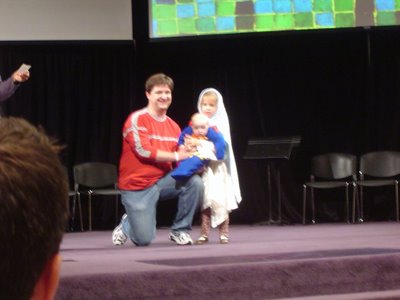
Here's the picture of them and me helping Kinsey with Connor. (Boy, if Connor gets my nose...)

Here's Connor all bundled up for the night.

Here's Kinsey and Connor at trunk or treat at Otter Creek on Sunday night. Kinsey is in her real Halloween costume, Princess Ariel at her wedding to Eric. Connor is Superman again, pumped up with some fluff in the arms to give him the right look. It's a lot fun with this right now and Kinsey is really enjoying it too.
Honestly these last five months feel like they've gone so fast and it's really making me stop and try to soak in these moments of their childhood. Barely 10 weeks ago, Kinsey was starting at Kindergarten and barely reading. Now she's reading mainly on her own, sounding words out and growing up so fast. Connor is almost sitting up on his own and eating cereal.
The great philosopher Ferris Bueller really was right. Life moves fast. If you don't stop and take a look around every once in a while, you'll miss it.
This year, we had a Superman costume for Connor and Kinsey's pretty easy to dress in a robe, so they were Mary and Jesus.
Our clues were 1) He was an unexpected arrival; 2) He was sent by his Father to stand for truth, justice and all that stuff; and 3) She was the mother of this "super-man."
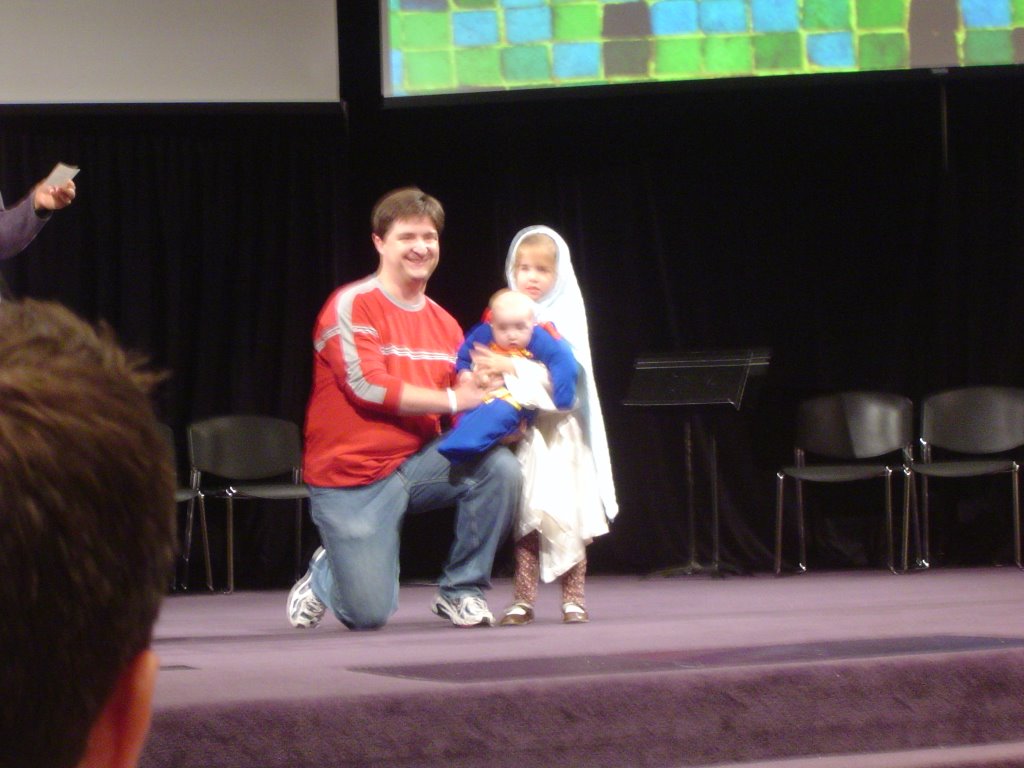
Here's the picture of them and me helping Kinsey with Connor. (Boy, if Connor gets my nose...)

Here's Connor all bundled up for the night.

Here's Kinsey and Connor at trunk or treat at Otter Creek on Sunday night. Kinsey is in her real Halloween costume, Princess Ariel at her wedding to Eric. Connor is Superman again, pumped up with some fluff in the arms to give him the right look. It's a lot fun with this right now and Kinsey is really enjoying it too.
Honestly these last five months feel like they've gone so fast and it's really making me stop and try to soak in these moments of their childhood. Barely 10 weeks ago, Kinsey was starting at Kindergarten and barely reading. Now she's reading mainly on her own, sounding words out and growing up so fast. Connor is almost sitting up on his own and eating cereal.
The great philosopher Ferris Bueller really was right. Life moves fast. If you don't stop and take a look around every once in a while, you'll miss it.
Monday, February 20, 2006
The Last Word by N.T. Wright
Ok, there's really no excuse for why I haven't finished this book. I'm 70 pages into it and it's only 140 pages long, but the thing about it is that it's a tough read.
N.T. Wright is an amazing thinker and writer and I've really gotten a lot out of the ideas he's presented and talked about. Particularly, when I heard the subject of The Last Word, I got very excited about reading it, because one of my interests is Scripture and how we interact with it. So I was very excited when Brad Crisler lent it to me (thanks, Brad [and update your blog!]).
Wright starts off the book by talking about the authority contained in Scripture and his basic intention is that Scripture is only authoritative in that it contains the Word of God. Now, if you're like me, that is a tough distinction to wrap your head around. Wright has address this subject earlier in a paper called "How Can the Bible Be Authoritative?" which you can find at www.ntwrightpage.com among other great papers and lectures. I guess being raised Church of Christ and being taught (and still believing to some extent) that the Bible IS the Word of God, to try and make a distinction between the two is just a tough leap to make. I'm still trying to work through it.
The rest of the book so far has been a VERY brief historical overview of how Scripture has been used, both through the Old Testament, New Testament, and in the post Testamental times. I'm up through the Reformation now and one of the things that I've appreciated about what Wright is doing is explaining how some terms have different meanings now than they did when they were first used. For instance, in the past, "literal" meant the actual words and their actual meaning, so when Jesus said, "This is my body," he meant that the bread he was breaking was his actual body (hence, the theology of transubstantiation), as opposed to how it's traditionally understood (by most Protestants, anyway), that Jesus was speaking metaphorically as we do now when we call the bread his body and the wine/unfermented grape juice his blood.
At any rate, I'm enjoying this book, even though I'm finding it tough to power through. Hopefully, I'll have it finished by next week and can discuss it a little more fully. And then I can borrow Paul: In Fresh Perspective from Brad next... in addition to all the other books I have and want to read like...
N.T. Wright is an amazing thinker and writer and I've really gotten a lot out of the ideas he's presented and talked about. Particularly, when I heard the subject of The Last Word, I got very excited about reading it, because one of my interests is Scripture and how we interact with it. So I was very excited when Brad Crisler lent it to me (thanks, Brad [and update your blog!]).
Wright starts off the book by talking about the authority contained in Scripture and his basic intention is that Scripture is only authoritative in that it contains the Word of God. Now, if you're like me, that is a tough distinction to wrap your head around. Wright has address this subject earlier in a paper called "How Can the Bible Be Authoritative?" which you can find at www.ntwrightpage.com among other great papers and lectures. I guess being raised Church of Christ and being taught (and still believing to some extent) that the Bible IS the Word of God, to try and make a distinction between the two is just a tough leap to make. I'm still trying to work through it.
The rest of the book so far has been a VERY brief historical overview of how Scripture has been used, both through the Old Testament, New Testament, and in the post Testamental times. I'm up through the Reformation now and one of the things that I've appreciated about what Wright is doing is explaining how some terms have different meanings now than they did when they were first used. For instance, in the past, "literal" meant the actual words and their actual meaning, so when Jesus said, "This is my body," he meant that the bread he was breaking was his actual body (hence, the theology of transubstantiation), as opposed to how it's traditionally understood (by most Protestants, anyway), that Jesus was speaking metaphorically as we do now when we call the bread his body and the wine/unfermented grape juice his blood.
At any rate, I'm enjoying this book, even though I'm finding it tough to power through. Hopefully, I'll have it finished by next week and can discuss it a little more fully. And then I can borrow Paul: In Fresh Perspective from Brad next... in addition to all the other books I have and want to read like...
- Christ Plays in Ten Thousand Place by Eugene Peterson
- God's Politics by Jim Wallis
- The Meaning of Jesus: Two Visions by N.T. Wright and Marcus Borg
- The Divine Conspiracy by Dallas Willard
- The Problem with Evangelical Theology: Testing the Exegetical Foundations of Calvinism, Dispensationalism, and Wesleyanism by Ben Witherington, III (who has a really interesting blog too)
- Theology for the Community of God by Stanley Grenz
Friday, April 22, 2005
England Travelogue Intro
First things first. Please pray for Ira Hays, newborn son of Joe and Laura Hays in NYC.
I’m going to do something a little different with the blog for the next two weeks.
Five years ago, Sheryl and I took a two week trip to England and Scotland, May 20 through June 3, 2000. This was before Kinsey was born and I had decided to quit teaching (Did you know I taught high school English for six years?). One of our dreams before we started our family was to go to England and Scotland without the encumbrance of children, so we saved up for the entire year, asking only for money as gifts for birthdays and Christmases. We had a great time. Honestly, it’s one of my top three memories behind getting married and Kinsey’s birth. It was a trip that lived up to every expectation I had and exceeded them.
The reason this is in the forefront of my mind is that Sheryl and I have agreed to participate in a trip to Loughborough, England in October with some singles from Otter Creek. I hesitate to call it a mission trip, since I’m starting to believe that my entire life is a mission to expand the Kingdom of God. We’re going to work with the local Church of Christ there and help with their Holiday Bible Class (HBC), roughly analogous to our Vacation Bible School here in the states. We’re really looking forward to it and even embarking on the adventure of taking Kinsey with us. Here's another explanation for the trip.
So, starting tomorrow, I’m going to post a travelogue that I kept on our trip back in 2000. I'll post everyday for the next two weeks, except for one day that you'll understand on the next day.
I hope you enjoy experiencing a little of what we did and post your comments.
2005 Thoughts
Post Trip Thoughts
Day Thirteen
Day Twelve
Day Eleven
Day Ten
Day Nine
Day Eight
Day Seven
Day Five
Day Four
Day Three
Day Two
Day One of the trip
Intro
I’m going to do something a little different with the blog for the next two weeks.
Five years ago, Sheryl and I took a two week trip to England and Scotland, May 20 through June 3, 2000. This was before Kinsey was born and I had decided to quit teaching (Did you know I taught high school English for six years?). One of our dreams before we started our family was to go to England and Scotland without the encumbrance of children, so we saved up for the entire year, asking only for money as gifts for birthdays and Christmases. We had a great time. Honestly, it’s one of my top three memories behind getting married and Kinsey’s birth. It was a trip that lived up to every expectation I had and exceeded them.
The reason this is in the forefront of my mind is that Sheryl and I have agreed to participate in a trip to Loughborough, England in October with some singles from Otter Creek. I hesitate to call it a mission trip, since I’m starting to believe that my entire life is a mission to expand the Kingdom of God. We’re going to work with the local Church of Christ there and help with their Holiday Bible Class (HBC), roughly analogous to our Vacation Bible School here in the states. We’re really looking forward to it and even embarking on the adventure of taking Kinsey with us. Here's another explanation for the trip.
So, starting tomorrow, I’m going to post a travelogue that I kept on our trip back in 2000. I'll post everyday for the next two weeks, except for one day that you'll understand on the next day.
I hope you enjoy experiencing a little of what we did and post your comments.
2005 Thoughts
Post Trip Thoughts
Day Thirteen
Day Twelve
Day Eleven
Day Ten
Day Nine
Day Eight
Day Seven
Day Five
Day Four
Day Three
Day Two
Day One of the trip
Intro
Subscribe to:
Posts (Atom)


